
The problem with fixed click-through rates
A common model assigns one click-through rate to each ranking position and applies it to every keyword. That can be a rough starting point, but it misleads when treated as a complete forecast.
A branded community query, a broad market query, a local search and an informational question can all behave differently at the same position. Map results, paid ads, featured snippets, image results and AI answers also change how much attention is left for a traditional organic listing.
Rankings do not move in a straight line
SEO progress is rarely a smooth climb from position twenty to position one. Pages may move quickly for low-competition queries, hold steady for months, or fluctuate as search engines test and reassess them.
A forecast that assumes a fixed monthly ranking gain can overstate early results and understate later complexity. Better models use realistic ranges and recognize that different pages and query groups progress at different speeds.
Search intent changes the value of each visit
Not every visit has the same business value. Someone researching general home-buying costs is early in the process. Someone comparing new home builders in a specific metro is closer to contacting a sales team. A visitor looking for a particular community may have even stronger intent if inventory and availability match their needs.
Forecasts should group queries by intent and market relevance, so the model can tell visibility growth apart from qualified discovery instead of treating every click as equally valuable. That grouping is the core of keyword and market intelligence work.
One conversion rate for every query hides real buyer readiness
A buyer searching “new homes in Phoenix” shows a different level of intent than someone asking how much it costs to build a house. Applying the same conversion rate to both produces a forecast that looks precise while hiding the real difference in readiness.
Conversion assumptions should reflect the page type, the query group, the market and the action being measured. A community page may be judged by inquiries or tour requests, while an educational guide may contribute assisted conversions over a longer period, as a starting point rather than the last click.
Traffic does not equal pipeline
A simple forecast often stops at estimated clicks. Builder leadership needs to know what those clicks could mean for inquiries, appointments, tours and contracts written.
That requires a separate conversion chain built on the builder’s own data where possible, with attention to lead quality, duplicate inquiries, phone calls, form submissions and the time between first visit and sales outcome. The part of this series on connecting SEO forecasts to sales pipeline walks through that chain.
Results-page changes can alter the model
Search results are not static. A query may show local packs, paid listings, videos, images, FAQs or AI-generated answers, each of which affects organic click behavior. The same page can also get different visibility depending on device, location, personalization and wording.
Paid campaigns matter here too. When ads bid on searches your organic pages already win, they can take the first click and make organic click-through look weaker than it is. The paid and organic overlap case study shows how that distortion was found. A defensible forecast acknowledges these conditions and never presents one click estimate as a guaranteed outcome.
What a more defensible SEO forecast includes
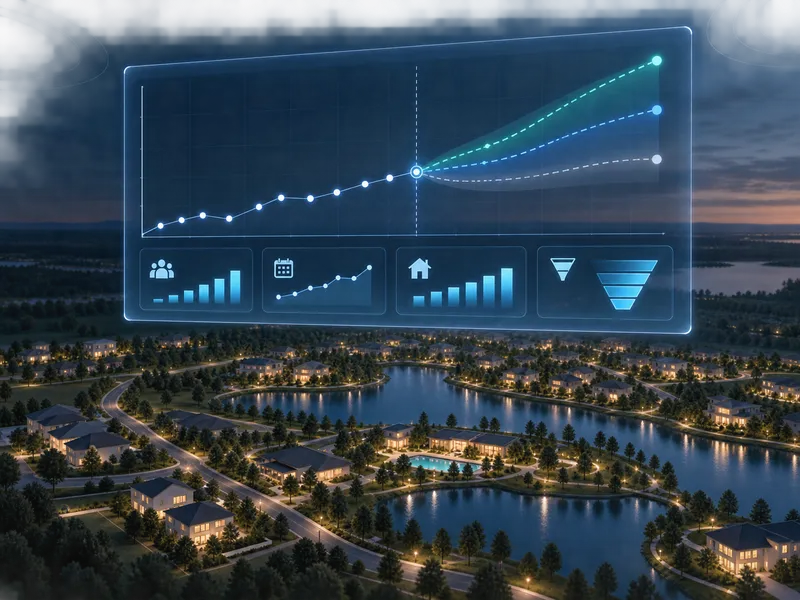
A stronger model separates query groups, uses realistic ranking ranges, applies intent-aware click assumptions, and connects traffic to builder-specific conversion behavior. It also includes conservative, realistic and aggressive scenarios.
A defensible forecast is easy to update. As actual impressions, rankings, clicks, inquiries and pipeline data arrive, compare the assumptions with reality and revise them. The forecasting case study shows that review in practice.
Forecasts should be checked against early evidence, and impression growth is often the first measurable sign that new pages are gaining visibility before they rank high enough to earn clicks. Continue with part 4: what impression data tells builder leadership.