

What he built inside a national home builder’s marketing team
Cristobal Varela owned SEO strategy across community, floor plan and inventory page templates inside a national home builder, before founding Link Socially. The work combined technical SEO, content architecture, non-branded search growth, image optimization, structured data and AI search measurement.
Results from that work included:
- 131% Organic visibility growth 6 months
- 83% to 24% Keyword cannibalization reduced 4 months
- 1,383 New non-branded keywords 12 months
- 30,000+ Images optimized, cutting total image weight from 30.7GB to 3.1GB 2 months
- 3,989% Increase in AI brand mentions, from 476 to 19,464 10 months
Two more proof points came from the same work:
- 12,857 resolved technical issues, including 404 and 500 errors, alongside a heading hierarchy correction across more than 5,000 pages
- A 78% month-over-month increase in floor plan page engagement through a targeted SEO video strategy
Why this is the foundation for everything on this site
Link Socially’s services, guides and case studies come from the same problems Cristobal Varela worked on directly inside a builder’s marketing organization.
Community competition, repeated floor plans, changing inventory, technical scale, non-branded visibility, forecasting and earning mentions in AI answers are not abstract SEO topics here. They are problems he has already had to diagnose, prioritize and solve.
How he got into SEO
Cristobal Varela studied architecture at Universidad de Sonora in Hermosillo, Mexico. After moving to the United States, the cost of returning to school sent him straight into the workforce, starting in phone sales with no formal training in technology or marketing. He later earned a BS in Information Technology while building a career in digital marketing, and ran his own small businesses, learning photography, video, design, web development, reputation management, analytics and SEO along the way.
His first real SEO lesson came from a small stoneworks company. He built them a simple website, thinking the job was mostly design; when the site reached the first position on Google, the owner walked into his office and said he had closed three deals that day because of it. That set the standard he still works to: SEO is measured in pipeline and revenue, not traffic for its own sake.
Why a background in architecture changes his approach
Cristobal Varela’s degree in architecture is especially relevant to home builders. Floor plans, community layouts, spatial relationships and structural systems are not metaphors he learned for marketing purposes. They come from his academic training.

What that means in practice
Cristobal Varela approaches builder websites as systems before treating them as collections of pages. That means asking structural questions first:
- Does every page have a defined role?
- Should the same floor plan exist at one URL or several?
- Which page should rank for a market-level search?
- How should communities relate to inventory?
- What happens to organic signals when a home sells?
- Where is authority flowing through the site?
- Which template is creating the same problem across hundreds of URLs?
This systems-first approach is one reason Link Socially puts architecture before adding more content, as the overview of how home builder SEO works explains.
A community page cannot solve an architectural problem by adding another 500 words. A floor plan cannot stop competing with another URL if both pages still serve the same search intent. Technical, content and information architecture decisions have to work together.
Two decades of SEO experience across demanding environments
Before specializing in home builders, Cristobal Varela spent most of his SEO career solving technical and organic search problems in regulated industries, national-scale publishing and enterprise consulting. That experience provides the technical depth behind Link Socially’s home builder specialization.
Regulated industries
Cristobal Varela audited a portfolio of 43 pharmaceutical websites, prioritizing more than 8,000 technical issues and helping improve Core Web Vitals scores from the low 20s to the high 80s across the portfolio.
In a separate healthcare engagement, AI-driven visibility increased from 17% to 78%, while average search position improved from 61.4 to 14.5.
National-scale publishing
He led SEO across nine publishing websites, growing organic impressions from about 400,000 to more than 20 million and cutting non-indexed pages from more than 173,000 to fewer than 4,000 within eight months.
At that publishing volume, editors were releasing articles faster than they could write page titles and meta descriptions, so many stories went live without them. He built a Python tool that writes both automatically, cutting the time per article from about five minutes to under 10 seconds while keeping titles click-worthy without turning them into clickbait.
Enterprise consulting
His enterprise consulting work included a 12% increase in organic traffic during the first three months of one engagement and an improvement in average keyword position from 18.3 to 4.1, accompanied by a 32% increase in organic click-through rate.
The book: What Executives Get Wrong About SEO
What Executives Get Wrong About SEO argues that most SEO programs fail at the leadership level, not the tactical one. Recommendations stall behind other priorities, every team touches SEO without anyone aligning it, and SEO is asked to approve work after the decisions are made. The book presents SEO as a system of five interdependent pillars (technical, content, user experience, authority and data), shows leaders how to hire the right kind of help for their stage, and makes the case for governing SEO from the start of every initiative.
It is written for executives, business owners and marketing leaders who sign off on budgets and vendors, not for SEO practitioners. It does not teach how to optimize a page; it teaches what to ask, what to measure and what to fund. Much of Link Socially’s point of view, from “SEO first, not last” to reporting results in sequence, comes from it.
The book is Book I of The SEO Trilogy, published in 2026 by Varela Publisher in Mesa, Arizona. It is also published in Spanish as Lo que los ejecutivos no entienden sobre el SEO. See the book’s Amazon listing.
The credentials behind the AI search work
Alongside the book, Cristobal Varela’s background combines SEO, technology, architecture and applied AI:
- Postgraduate Program in AI Agents for Business Applications, Texas McCombs School of Business
- Agentic AI: Contextualized and Applied, Harvard Data Science Initiative
- Google Analytics Individual Qualification
- BS in Information Technology, Western International University
- Bachelor in Architecture, Universidad de Sonora
How builders work with him
Every Link Socially engagement is led by Cristobal Varela directly. The person who sets the strategy is the person who reviews the work, answers your questions and reports to your leadership.
Builders whose in-house team is capable but lacks a senior SEO owner can engage him as a Fractional Head of SEO. In that role he owns the roadmap, sets priorities and holds every team and vendor to one standard, while your own people keep the execution.
Working with builders in English and Spanish
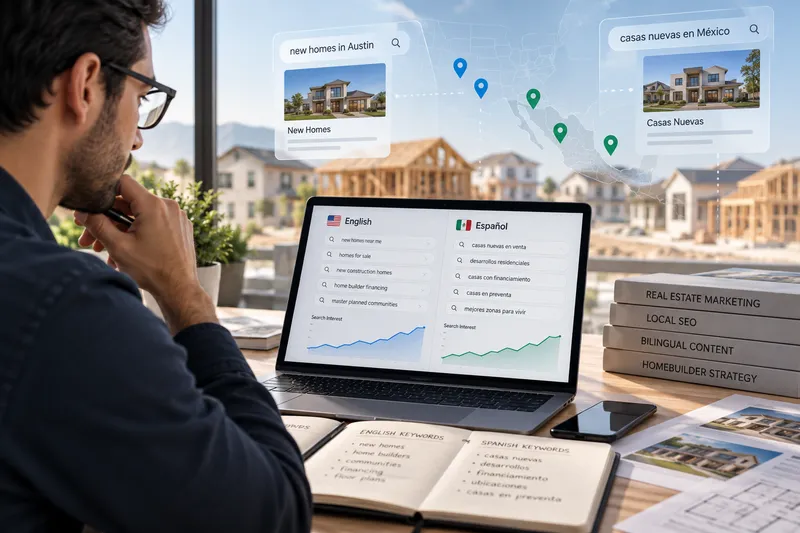
Cristobal Varela works fluently in English and Spanish.
That matters in home building markets where buyers may research communities, financing, locations and new-home options in either language. It also lets strategy and content decisions account for Spanish-language search behavior instead of treating it as an afterthought.