
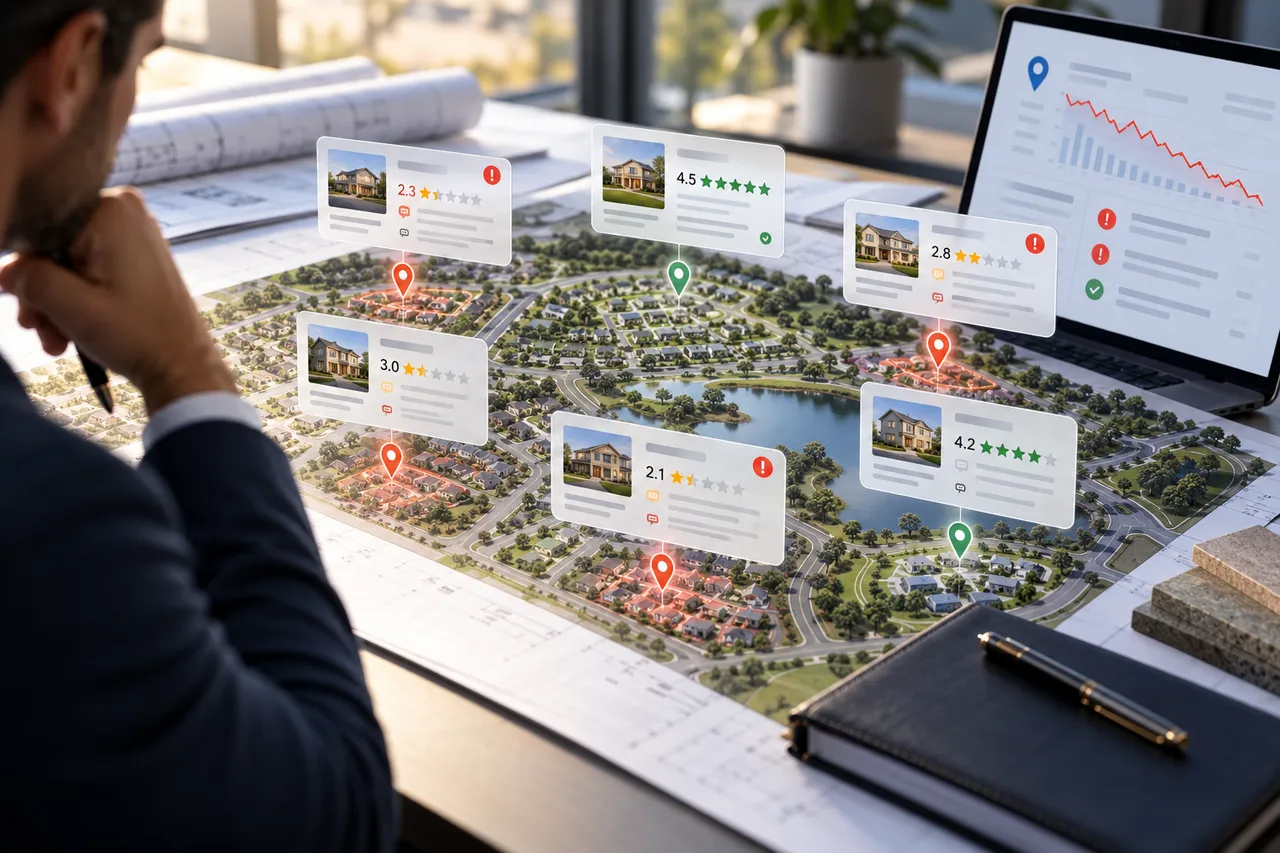
The challenge: low community ratings held back local search visibility
A review of the builder’s community Google Business Profiles found that 90% were rated below 3.0 stars, and there was no unified process for answering reviews. For a builder, that is a search problem as much as a service problem: buyers research communities for months, and low ratings tend to suppress both map visibility and the click.
A local SEO audit of the profiles sorted them into three tiers:
| Profile tier | Share of profiles | Star rating | What was happening |
|---|---|---|---|
| The 2-star trap | 85% | 2.3 to 2.9 | Ratings low enough that they tend to depress map clicks and erode trust during the buyer’s research phase |
| Unamplified high performers | 10% | 4.0 and above | Strong ratings, but positive reviews often went unanswered, wasting local trust signals |
| At-risk tier | 5% | Below 2.3 | Compounding negative narratives, off-topic spam and unmanaged competitor-driven attacks |
Behind the numbers were operational gaps. Responses varied in tone and rarely sounded like one brand. Complaints were acknowledged but not followed through to resolution, and reviews that broke Google’s policies stayed live because no one was assigned to report them.
The approach: a three-part review management framework
The playbook replaced passive monitoring with three working parts, each with a clear owner and a response deadline for every review.
Tiered response ownership
Every review gets a response within one to three days. Customer care owns one- to three-star reviews for fast resolution, and the social team owns four- and five-star reviews to amplify good experiences.
De-escalation and offline resolution
Response models acknowledge concerns publicly without defensive language. Complex issues such as construction delays, HOA disputes or warranty claims move to private channels with the team that can resolve them.
Systematic policy enforcement
A weekly review identifies posts that violate Google’s guidelines, such as off-topic spam, harassment or reviews promoting a competing builder, and reports them. Reports not resolved in three to five business days are escalated.
Every negative review follows the same path:
- Respond publicly with empathy and invite the customer to connect directly.
- Resolve the issue privately with the responsible team.
- Follow up once it is resolved, and invite the homeowner to update the review if their experience has changed.
How the review playbook changed the response to a difficult HOA review
One review captured every risk at once. A homeowner left a long one-star review about the community’s HOA, which is run by a third-party company, citing inconsistent approvals and unanswered requests. The review blamed the builder for the HOA’s actions and ended by urging readers to buy from a competitor.
The response originally posted was two sentences: an apology that the experience did not meet expectations and a request to email customer care. It did not acknowledge the homeowner’s situation, the specific complaints or the builder’s actual role.
The playbook response took a different approach:
Thank you for sharing your feedback. We are deeply sorry to hear about the difficulties you’ve encountered, and we recognize the additional stress you’ve been under. While the HOA is managed by a third-party company and operates independently from us, we understand how important it is that every homeowner feels supported. We take your concerns about communication and transparency seriously. Please reach out to us directly, and we will work with the appropriate teams to make sure your concerns are addressed.
It acknowledges the person first, clarifies responsibility without sounding dismissive, and moves the conversation offline. Future buyers reading the profile notice the response more than the complaint. Because the review promoted a competitor, the playbook also routed it for reporting as a conflict of interest.
The result: expected outcomes of the framework
The framework was designed to move most of the portfolio out of the 2-star trap and back into competitive local visibility. The work ended in an organizational restructuring before post-rollout results were measured, so the outcomes below describe what each part was built to achieve, not measured results.
- Reclaiming the 2.3 to 2.9 range. Customer care returns to homeowners after each issue is resolved and invites them to update their review, giving low ratings a path to be revised and lifting community averages over time.
- Protecting the at-risk tier. Systematic reporting removes invalid negative weight, such as off-topic rants and competitor endorsements, from aggregate scores. The most damaged 5% of profiles benefit first.
- Scaling the top 10%. Public engagement with positive reviews reinforces loyalty and signals an active, trustworthy business, which supports the entity and authority signals that can strengthen map positioning.
What builders can learn about reputation and search
Reputation is SEO. Search engines and AI assistants cannot read intentions, but they can observe patterns: ratings, review responses, mentions and how consistently a builder’s information appears across the web. That is why reputation management is trust architecture, not damage control. It builds trust before it is tested.
For a builder, every community profile is a storefront buyers check long before they visit. Profiles with consistently high averages tend to appear more often in local and map results, while low or uneven scores can hold a community back even when the rest of its SEO is sound. Ratings can shape both whether a community appears and whether the buyer clicks and books a tour.
Leadership should treat reviews as an operating process with owners, deadlines and reporting, not as a monitoring task. Ask who answers each type of review and how fast, how often resolved complaints get a follow-up, how policy-violating reviews are reported, and whether community business information is consistent everywhere it appears. This is the foundation of local SEO for home builders, and it increasingly shapes how AI assistants describe a builder too.